

Unmanned Systems Forces Day: While the World Is Catching Up, We Are Already One Step Ahead
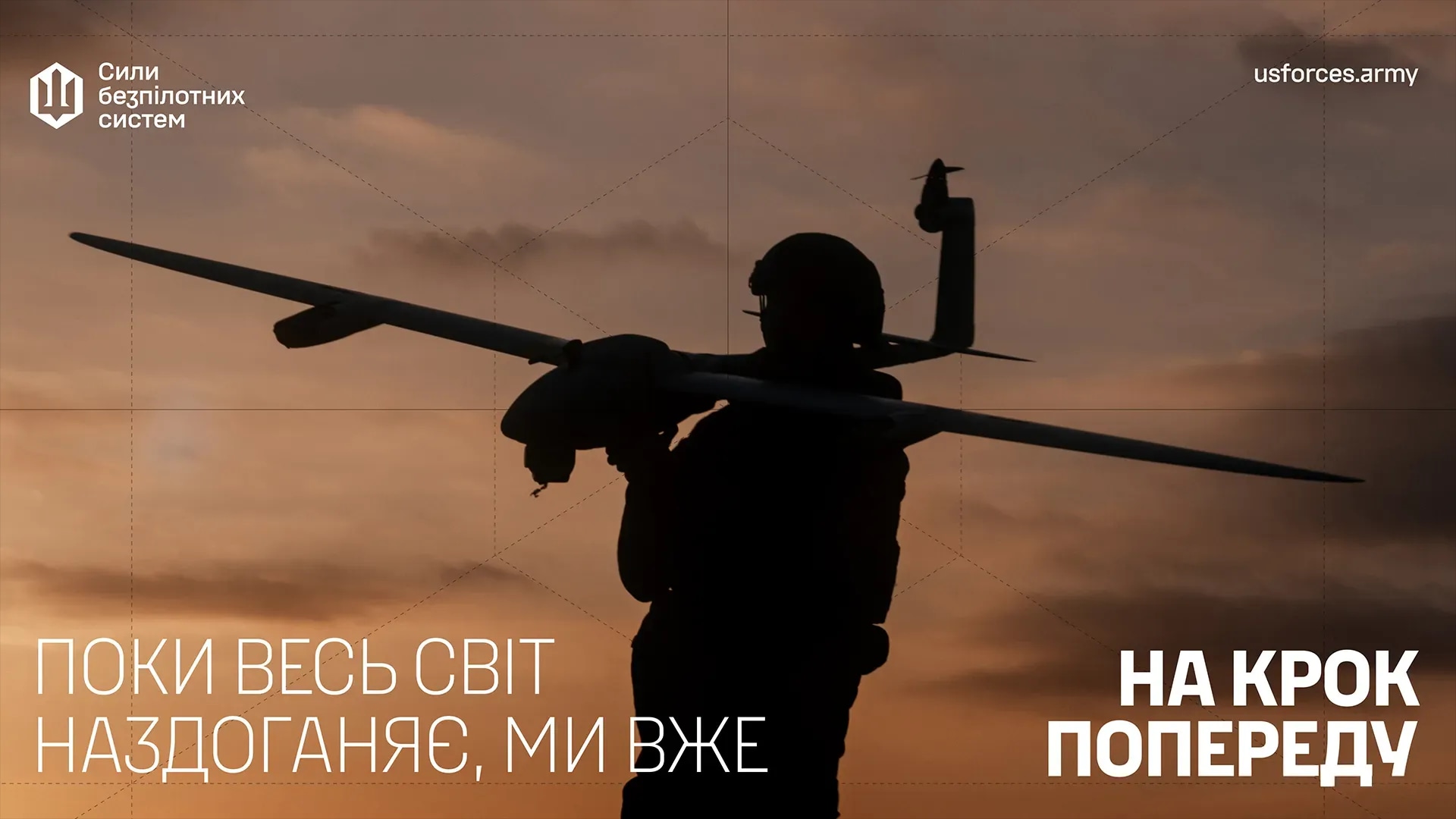
Just a few years ago, no one could have imagined that sirens would sound in the middle of the night in the capital of the aggressor state, and that the very concept of a "safe rear" would cease to exist. Today, Ukraine's Defense Forces are making exactly that happen.
This tectonic shift in the philosophy of modern warfare did not happen on its own. It is the result of the global integration of technology into the strategies of Ukraine's Defense Forces and the creation of a separate military branch capable of acting asymmetrically, effectively, and without compromise. Today, the Unmanned Systems Forces of the Armed Forces of Ukraine are proving in practice that the future has already arrived — uniting aerial, naval surface and underwater drones, as well as ground robotic systems, under a single command.
Evolutionary pressure: where it all began
In nature, there is a phenomenon known as evolutionary pressure — a harsh process in which only the most adapted survive. The same law applies on the battlefield. It was this merciless pressure that drove the creation of the USF, exposing the urgent need to systematize unmanned units and develop a fundamentally new vision of warfare.
A strategically precise start made rapid forward momentum possible. Individual regiments are evolving into powerful brigades. Long-range deep-strike attacks are no longer a media sensation but a standard of daily work. 2,000 km is now simply the reach of the outstretched wings of Ukrainian drones. In-house R&D centers make it possible to implement the latest engineering solutions instantly, while a robust support system enables everyone determined to bring victory closer to fight effectively. At the same time, an extensive network of training centers and courses continuously produces top-tier specialists.
Yet the USF's main strength is its people. The genuinely humane attitude of commanders toward their subordinates and a relentless focus on preserving the lives of personnel are the rock-solid foundation on which the entire internal culture of the branch is built.
Operations of 2026
Today, the whole world is watching the USF's unique experience with bated breath, trying to grasp what the war of the future looks like. But while foreign experts are still analyzing the theory, we are confidently moving forward, etching our achievements into the pages of history.
The numbers speak for themselves: according to the Delta military situational awareness system, every third target hit and every third confirmed enemy personnel loss is the result of the Unmanned Systems Forces grouping. It is also worth noting that USF units consistently rank among the top ten most effective units of Ukraine's Defense Forces. And since the grouping's creation, USF units have hit more than 100,000 enemy personnel.
This year alone, USF fighters have carried out hundreds of lightning-fast operations — each one worthy of a Hollywood film. They simply would not all fit into a single article, so let us recall just a few of the most iconic ones. But before we move on to the facts and figures, every reader should do one simple yet crucially important thing: mentally thank the people behind these titanic changes. Those whose persistence, intellect, and daily grueling work turned the skeptical "no one has ever done this before" into a proud and undeniable "We did it!" So here we go.
Hunting the "Alligator"
March 20, 2026, Pokrovsk direction. The mission was preceded by a month and a half of meticulous preparation. Aerial reconnaissance teams gathered intelligence bit by bit, analyzed potential flight routes of enemy helicopters, calculated precise launch points, and studied exit trajectories. The result was a one-of-a-kind kill: fighters of the 59th Brigade "Steppe Predators" completely destroyed a Russian Ka-52 attack helicopter. The state-of-the-art helicopter, worth tens of millions of dollars, was taken down by a fiber-optic FPV drone.
Guiding the strike on the Kremniy El plant
This is the first known case in which a strike on a strategic enterprise of the Russian defense industry was adjusted in real time by a UAV. In March 2026, fighters of the 413th Regiment "Raid" provided live correction for Storm Shadow cruise missile strikes on the Bryansk microelectronics plant. The facility produces components for the missiles that strike Ukraine — among them the Izdeliye-30 cruise missile, which killed 11 people and wounded 16 in Kharkiv on March 7, 2026.
Playing the long game: how Deep Strike is zeroing out the enemy's oil empire
The Unmanned Systems Forces' Deep Strike attacks are not isolated raids for the sake of loud headlines, but a deliberate, high-tech long game.
The ports of Primorsk and Ust-Luga are key arteries that handle up to half of all seaborne exports of Russian oil. Together with the Yaroslavl and Ryazan refineries, they form a single production chain critical to the Kremlin, through which nearly 30% of all Russian output passes. Rapidly rerouting or mothballing such enormous volumes of crude is impossible.
Systematic strikes by USF units, in coordination with other components of the Defense Forces, have completely severed this chain. Our work was preemptive and cyclical: after attacks on the Baltic port terminals, the raids immediately shifted to the refineries, and vice versa. Less refining — harder logistics — instant collapse of the entire infrastructure. The enemy's oil system faced critical overpressure, excessive crude accumulation, and a total shortage of storage capacity. For the occupiers, the white nights suddenly turned black with smoke.
While the Baltic was burning, in southern Russia USF units, together with other components of Ukraine's Defense Forces, carried out one of the most illustrative cases of the systemic approach — the isolation of the Tuapse refinery. In just two weeks, the facility was methodically struck four times. The consecutive, uncompromising hits did not merely destroy processing units — they completely paralyzed any attempts to restore the plant. On this front alone, the aggressor's monthly losses exceeded $300 million.
Such cyclical, coordinated strikes clearly demonstrate the USF's ability to systematically multiply Russia's military-economic potential by zero.
The world's first interception of a Shahed from a surface platform
Russian Shahed attack drones long used the sea as a radar "blind spot," sneaking toward Ukrainian cities at extremely low altitudes. To close this space, operators of the unmanned surface systems division of the 412th Brigade Nemesis took short-range air defense out to the open sea. They deployed patrols of autonomous unmanned surface vessels, each carrying several aerial interceptor drones. The team had calculated the routes and behavior scenarios of enemy aerial targets in advance. The historic kill was achieved by a crew led by an operator with the call sign "Demon" — a volunteer and former infantryman who had transferred to Nemesis just a few months earlier. Tellingly, this world-first precedent occurred during the very first combat sortie of Dmytro's crew, ending in an instant technological triumph.
Hunting communications: the R-416G-MS
In late March 2026, in Luhansk region, a drone of the "Phoenix" border guard unit struck one of Russia's rarest mobile radio relay stations — the R-416G-MS, worth around $600,000. This is only the second confirmed destruction of such a system during the full-scale war, and it completely deprived the occupiers' command of encrypted communications in that sector of the front.
K-2's robotic mission
Fighters of the 20th Brigade successfully evacuated the bodies of nine fallen defenders that had remained in the "gray zone" under relentless fire since November 2025. Dense mining and continuous enemy FPV drone attacks made conventional evacuation impossible. Despite the colossal risks, the unit planned a unique operation using unmanned ground vehicles (UGVs). The route through minefields and engineering barriers was scouted by Mavic operators, who then escorted the robots from the air, helping them evade enemy fire. The experienced crew managed to guide two platforms at maximum load simultaneously and successfully recovered the heroes' bodies from three different locations.
A daily record: 256 in 24 hours
On April 30, 2026, the "Magyar's Birds" brigade set an absolute record, logging 256 confirmed eliminated occupiers in a single day. Thanks to a non-stop conveyor of reconnaissance, strike, and FPV drones, one unmanned unit stopped a massive assault within 24 hours and destroyed an enemy battalion, holding the front without committing infantry reserves.
Two in one
The 429th Brigade "Achilles," together with the 43rd Separate Artillery Brigade and the "Alpha" Special Operations Center, struck two enemy helicopters in Russia's Voronezh region — an Mi-17 and an Mi-28. At the time of the operation, the aircraft were on the ground, likely undergoing maintenance. Enemy personnel were hit along with the hardware. Two aircraft, one strike, over $33 million in damage — and minus two helicopters that will never fly again.
What's next? Next — only more
Deep strikes: attacks that cannot be stopped
The Unmanned Systems Forces are systematically destroying what fuels the Russian economy: oil refining capacities, export ports, military plants, and key logistics hubs at depths of up to 1,500–2,000 km. The operational logic of deep strikes remains constant: every deep raid is closely tied to prior work at the front-line and mid-strike levels.
Mid-strikes: dismantling enemy air defense step by step
Successfully hitting targets deep in the enemy's rear is impossible without disorganizing its air defense. That is precisely the task of mid-strikes — night raids against radar stations, surface-to-air missile systems, communications nodes, and command posts at operational depth.
Interceptors: drones versus drones
Every day, russia launches hundreds of Shahed attack drones and reconnaissance UAVs at Ukraine. The USF counters this onslaught with a technological alternative: interceptor drones that take down enemy UAVs in the air, saving the scarce and expensive missiles of traditional air defense.
Engaging enemy personnel: "Standard-10"
To break the enemy's offensive potential, USF Commander Robert "Magyar" Brovdi formulated a mathematical formula for turning the tide of the war — "Standard-10." Its essence is simple: every strike crew must achieve at least 10 confirmed hits on enemy personnel per month. This systemic approach is already delivering strategic results. According to verified Delta system data, in March and April 2026 the unmanned systems of Ukraine's Defense Forces accounted for more than 33,000 confirmed enemy personnel losses per month. Meanwhile, russia's average monthly mobilization rate stood at around 29,500.
The result is clear: for the fifth month in a row, the russian army has been losing more personnel at the front than its system manages to mobilize. The Ministry of Defense has now set a new strategic goal — the demilitarization of 50,000 occupiers per month. With the scaling of "Standard-10" and the continued growth of the Unmanned Systems Forces, that figure is becoming an entirely achievable mathematical reality.
We evolve faster than the enemy can adapt
One thing can be said with confidence: the largest operations of the Unmanned Systems Forces are still ahead. The unique system built within the grouping by the finest warriors, engineers, and commanders has already proven its unquestionable effectiveness. This is clearly confirmed by verified results, the occupiers' colossal losses at every level of operational depth, and — most importantly — the people who, day after day, make possible what was once considered science fiction. The peregrine falcon is only spreading its wings. Units are scaling up, systems are being refined, and capabilities are growing by the day. The enemy has already felt the consequences of our work — and will keep feeling them.
If you are already a warrior of the Unmanned Systems Forces — thank you for your contribution to this transformation. For every sortie, every strike, every night on position. And for those who want to watch Ukraine's technological edge take shape — or to become part of it: follow our work in real time and subscribe to the grouping's official channels. Stay at the epicenter of events!
USF: One step ahead!
