

Ukraine’s Stealthy Drone Warriors
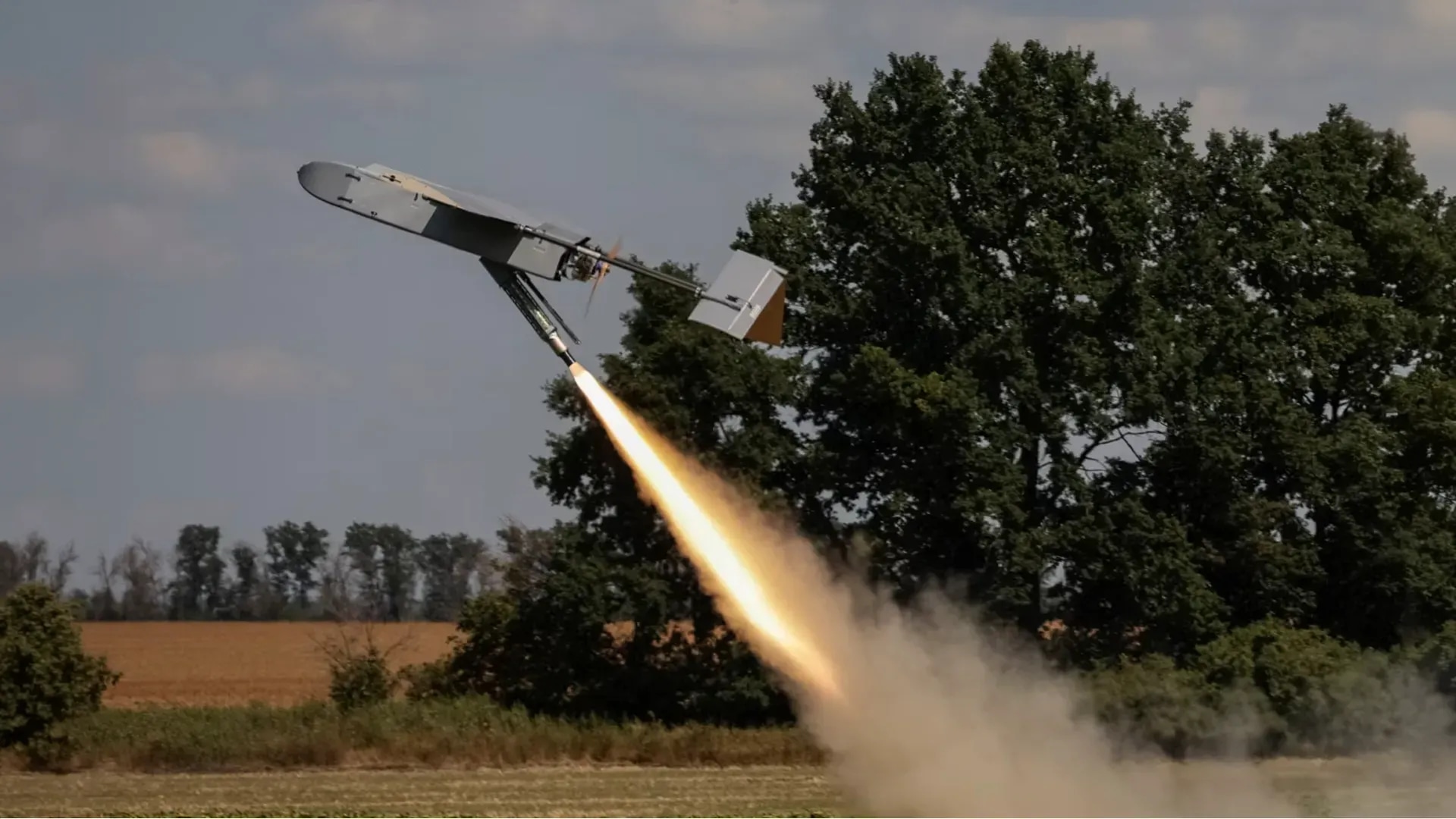
Midrange drones have degraded some Russian electronic-warfare systems and hobbled 300 vessels.
Southeastern Ukraine
The scene resembles the Ukrainian flag: yellow fields of corn, sunflowers and wheat, a crisp blue September sky. We park on the perimeter of a field, in the shade of a row of lindens. “These trees are quite inhabited,” says my guide—call sign Leon—a soldier in a brigade of Ukraine’s Unmanned Systems Forces known as Magyar’s Birds. Under the dense foliage, soldiers on the ground work in what looks like a pumpkin patch. Instead of tending squash, they are rigging 12 fixed-wing drones with 22 pounds of explosives. “Agriculture in Ukraine,” Leon says with a smile.
These drones have a range of up to 250 miles, enough to cover all the Ukrainian territory Russia occupies. Today they’ll fly toward Novoazovsk, a district of Donetsk between Mariupol and the Russian border. A Magyar’s Birds reconnaissance team spotted a cluster of expensive enemy vehicles—a “tasty” or “juicy” target, the soldiers say.
Given the risk of Russian reconnaissance, the plan is to “get in, get armed, and get in the air” fast, Leon says. Launching a drone is far less cumbersome than firing a missile. The foliage conceals the drones as they are prepared, and a barn could do the same in the winter. On larger missions involving several dozen drones, the Ukrainians might use several launch sites. The launches are dispersed and inconspicuous—making them harder for the Russians to counter. In the Middle East, the U.S. and Gulf partners are struggling against Iranian drones for similar reasons.
The drones I saw were rigged with explosives powerful enough to penetrate 11 inches of steel in a direct hit. The research-and-development department of Magyar’s Birds custom-makes as many as 100,000 warheads a month for short- and midrange strikes and supplies more than a dozen other units, mainly within the Unmanned Systems Forces. Magyar’s Birds assemble more than 50 different models, each calibrated for the specific type of drone and target.
Once the drone is ready, soldiers gingerly place it on the catapult launcher. As propellers whir during warm-up, one drone’s camera shakes. An engineer tinkers and steadies it so the pilot will have a stable view. But generally the drones arrive mission-ready, partially a result of “continuous feedback” with Ukraine’s arms developers, says the field commander, who goes by the call sign Cousteau. The drone rises, then disappears into the sky. “Two years ago, we needed to have our pilots near us,” and proximity put the pilots at risk, Leon says. Today with an internet connection they can fly from hundreds of miles away.
Leon later updates me on the mission’s results, with footage. Unmanned Systems Forces units get credit for a kill only if they have video proof. The Russians shot down two midrange drones, and another was lost after communications went down, possibly because of electronic warfare. One more missed its target. But the remaining eight hit their marks. The mission destroyed four Russian military cargo trucks and three fuel trucks and damaged an additional fuel truck.
“We understand logistics is the blood flow of war,” says Maj. Robert “Magyar” Brovdi, commander of Ukraine’s Unmanned Systems Forces. Until now, to cut a logistics artery, you needed to position infantry close enough to hit targets with artillery, lay mines or blow up bridges. “But now,” Maj. Brovdi says, “the question is only the availability of drones and the quantity of drones.”
Such an interdiction campaign is one feature of the Third Army Corps’ Operation Vivaldi, which has thwarted a Russian offensive aimed at encircling the Ukrainian eastern defensive stronghold known as the Fortress Belt. Third Army Corps also says it has recently reclaimed about 68 square miles in the direction of Lyman, a city in the Donetsk region. One example of how midrange strikes helped there: Some of Russia’s electronic warfare systems run on generators, so hammering fuel logistics helped degrade this enemy capability.
Maj. Brovdi cites other recent successes. Oil and gas revenue pays for Vladimir Putin’s war, and Russia uses its shadow fleet to evade sanctions and smuggle fuel abroad. Since July the Unmanned Systems Forces have targeted these vessels in the Black Sea and the Sea of Azov. Sinking an oil tanker could cause an environmental disaster, but it’s easy to incapacitate the vessel with a drone strike on a crucial area like an engine room. Maj. Brovdi says that as of Sept. 22, his soldiers had turned 300 Russian vessels into “drifting warehouses in the sea . . . incapable of moving by themselves.”
He says his troops are also blockading Crimea “without a foot on the ground” and without any losses from the Unmanned Systems Forces. Attacks on missile launch sites in Crimea have dramatically decreased the number of ballistic and cruise missiles launched from that direction, he says. If it had Starlink access over Russia to go after more mobile missile launchers, Ukraine could further erode the enemy’s ability to hit Kyiv and other cities.
“The aim is to create a systematic effect, not only to disrupt logistics,” Leon says. Ukraine’s midrange strikes on air defenses leave Russian forces at the front more vulnerable. They also open a corridor for Ukraine to conduct aerial attacks deep in Russia while stretching the Kremlin’s air defenses even thinner. The Russians are adjusting to the midrange strikes, in part by moving men and munitions stealthily in civilian vehicles. They also have increased the number of mobile fire groups that try to shoot down Ukrainian drones.
The Unmanned Systems Forces has identified thousands of potential Russian targets, and it has crews ready to take them on. But Ukraine’s most acute problem remains supply. Leon estimates the Unmanned Systems Forces has only 14% of the midrange drones it needs.
The article appeared in the print edition of *The Wall Street Journal* on October 1, 2026, under the headline “Ukraine’s Stealthy Drone Warriors.” The author, Jillian Kay Melchior, is a member of *The Wall Street Journal*’s editorial board in London.
Source: https://www.wsj.com/opinion/ukraines-stealthy-drone-warriors-f5d4fa38?st=tiBBbC
